Matted London
Matted London: scattered tools, one clean system
A London hair studio with a full book and no system behind it. The work was excellent and the website undersold it, so the site did the opposite of its job: it made a careful business look casual.
| Metric | Before | After |
|---|---|---|
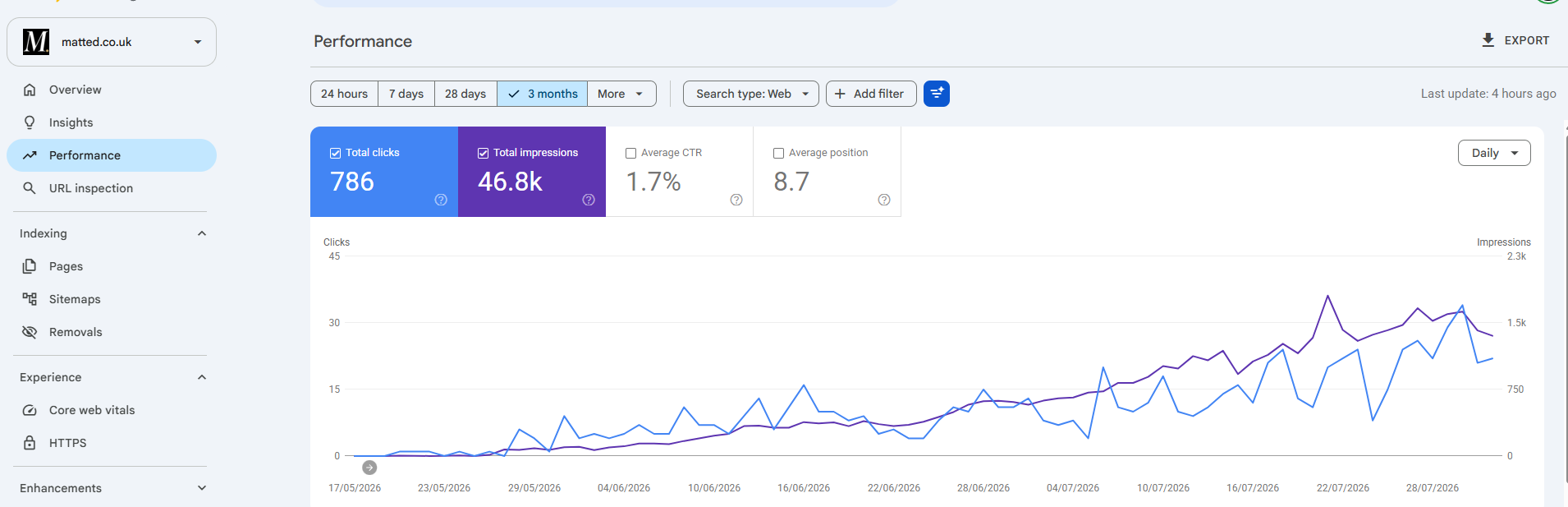
| Google Search Console impressions | 0 | 98,400 |
| Clicks from search | 0 | 1,440 |
| Average position | not ranking | 8.6 |
| Click-through rate | not ranking | 1.5% |
| Booking | DMs and memory | Structured intake and booking |
| Inquiries | Lost in the inbox | Captured and routed on arrival |
| The site itself | Undersold the work | A presence that closes |
What I found
Bookings arrived through Instagram DMs, and the record of them lived in the founder's head. That works until the day it does not, and the failure is silent: nobody can tell you about the appointment that was never made because a message scrolled out of view on a busy Friday.
The website was the second problem, and it was the one holding the first in place. It described the studio accurately and sold nothing. There was no intake, so the only route to a booking was a message, which meant every inquiry had to pass through a person before it could become anything.
Inquiries that did arrive by email landed in a general inbox with no owner and no follow-up. That is the most expensive pattern in a small service business, because it fails invisibly. A lost lead does not complain. It simply books somewhere else, and the business concludes it needs more marketing.
Underneath all of it was a search problem nobody had looked at. The site existed and was technically live, but very little of it was structured in a way that could be found, so the studio was competing for attention it was never actually in the running for.
That last one is worth separating from the others, because it is the kind of problem that does not announce itself. Nothing was broken in a way anyone would notice. Pages loaded, links worked, the studio appeared when you searched for it by name. The gap only shows up when you ask a different question: how does someone who does not already know this business ever arrive at it?
Put those four together and you get a business whose ceiling had nothing to do with the quality of its work. Demand was not the constraint. The constraint was that every route in ran through a person, and a person is only available some of the time.
What I built
Intake first, because it was the front door and the place where losses cost most. Structured booking replaced the DM thread, so a request arrives as a record rather than as a message someone has to notice. Every inquiry now gets captured, routed and acknowledged without anyone having to remember to do it.
Then the site itself, rebuilt around what someone actually needs to see before they are willing to book. The studio's work is the strongest argument it has, so the rebuild put it where people look first instead of behind a menu. No templates were used, which mattered here: the whole problem was a business being represented as more generic than it is.
Then the part that produced the number in the table. Real page structure, content that exists in the HTML rather than being assembled by JavaScript afterwards, metadata that describes each page, and internal links so the pages could actually be reached. None of that is clever. It is the baseline that decides whether a good site is visible at all, and it is the same work this studio's own rebuild started with.
The sequencing mattered more than any individual decision. Intake was fixed before the redesign shipped, so that by the time the site started sending more people toward a booking, there was something on the other end capable of receiving them. Doing it the other way round is the common mistake, and it produces a business that looks busier while converting the same or worse.
Nothing was locked down at the end. The accounts are in the studio's name, the booking flow is documented, and the site can be edited without me. That is the standard on every project, and it is worth stating in a case study because the alternative is common enough that people assume it.
The final result feels premium and works smoothly.Vitalii Prisacari, Founder, Matted London
What I took from it
The impressions number is the headline, but it is not the interesting part. What made it possible was that the pages became reachable. Before the rebuild the site was not being penalized, it simply was not structured in a way that let anything find it, which is a much more common problem than a penalty and a much less dramatic one to fix.
The second thing is about order. It would have been possible to redesign the site first and leave booking on DMs, and the studio would have had a better-looking front end feeding the same leaky process. Intake went first because a site that sends more people into a broken booking flow makes the problem larger, not smaller.
The third is the one I keep returning to on other projects. Nobody in this business knew how many inquiries were being lost, because there was no place where a lost inquiry would show up. You cannot fix a number you have never seen, and most small service businesses are carrying at least one of those.
This is also why the before and after numbers get published rather than described. A case study that says a site was improved is a claim. A case study with a figure attached to a named client is something you can push back on, and that difference is most of what makes it worth writing.
It is worth being precise about what these figures do and do not show. Impressions measure visibility: how often pages appeared in results. The 1,440 clicks are the people who actually arrived. Neither is a revenue number, and an average position of 8.6 means most of those appearances were near the bottom of the first page, which is a real result and also a lot of remaining headroom. Studios that blur that line are usually hoping you will not ask.
The click-through rate is in the table for the same reason, at 1.5%, which is below the 2% I would want to see. That is the honest read: visibility arrived faster than the titles and descriptions earned clicks from it, and it is the obvious next thing to work on rather than something to leave out of the screenshot. It has also fallen at every capture since 3 August rather than risen, because impressions grew faster than clicks did each time. A number going the wrong way is worth publishing for the same reason as the rest of them.
The window matters too. All of it comes from one three month period in Search Console, start and end, which is the only way a before and after means anything. The curve was still climbing when the window closed, so these are not settled numbers, they are a trajectory caught partway.
The old version of this page carried four other statistics, and none of them was a result this studio produced. A hair-save rate, a founding year, a city, and a count of templates not used. They are all true and none of them belongs in a case study, because a case study is an argument about what changed, and none of those changed.